
Catching the Treasure: Reflections from Google Cloud Summit Builder Connect Poland
Yesterday morning started at 05:00 in Łódź. I packed my backpack and grabbed my bicycle. Then I pedaled to Łódź Fabryczna station to catch the early PKP Intercity train to Warsaw for Google Cloud Summit Poland 2026. This was my second time commuting by bike on the train to Warsaw. The connection is convenient, and having an hour of quiet train time with a coffee before a busy conference gives you space to think.

At the venue, they ran a Builder Connect Treasure Hunt where you collected stamps from partner booths on a card to claim a swag bag. It was a fun icebreaker for exploring the hall, though my real goal was finding practical engineering insights to bring back home.

The hallway conversations quickly turned to running autonomous agents, guardrails, and browser tooling in production.
GitOps Guardrails When Code Generation Costs Drop
One session that stood out was led by Jarosław Gajewski on managing autonomous agent pull requests.
“Never Trust, Always Merge: Zero-Trust GitOps for Autonomous Agents”
When an agent can scaffold a microservice or open twenty pull requests in an hour, the bottleneck shifts completely. You cannot review that volume of code manually without burning out or stalling the team. Cheap code generation makes product restraint crucial, an architectural trade-off I covered in Modern Tooling and Minimalism in Early-Stage Teams.
Jarosław walked through handling agent contributions with strict boundary checks. That means running static analysis alongside immutable audit logs at the GitOps layer before anything touches a runtime environment.
Agent autonomy works best when guardrails are solid. If our static analysis and CI/CD checks catch regressions reliably before deployment, we can comfortably let agents run with less supervision. Finding that boundary takes time. You define it as you build the product.
Replacing Ad-Hoc Testing with Synthetic Datasets
Catching regressions with static analysis solves one part of the problem. But what happens when static checks pass, the pull request merges, and the model still fails silently at runtime?
Łukasz Olejniczak presented a grounded session addressing this challenge with agent quality assurance and synthetic evaluation datasets.
Testing language model workflows by tweaking prompts manually falls apart quickly. As soon as you change a prompt template or Google updates the underlying foundation model, unexpected regressions slip into production. Łukasz showed how structured agent QA uses domain-specific synthetic test suites instead of manual prompt inspection.
When an agent says something works and it doesn’t, you need a reliable way to catch those false greens and run a proper retrospective. I put these ideas into practice in Evaluating Prompts When Decimals Cost Thousands, building deterministic synthetic benchmarks to verify prompt outputs before deploying them into automated pipelines. Running agents against synthetic edge cases gives you concrete test scores and verification checks, so you know where the boundaries hold before deploying to production.
Native Tool Calling in the Browser
Beyond backend pipelines, client interfaces are adapting to agentic workflows. Kasper Kulikowski from the Chrome AI team gave an engaging session introducing WebMCP and the open-source webmcp-tools repository. I caught up with him after the talk, and we discussed how client-side tool calling actually runs in practice.
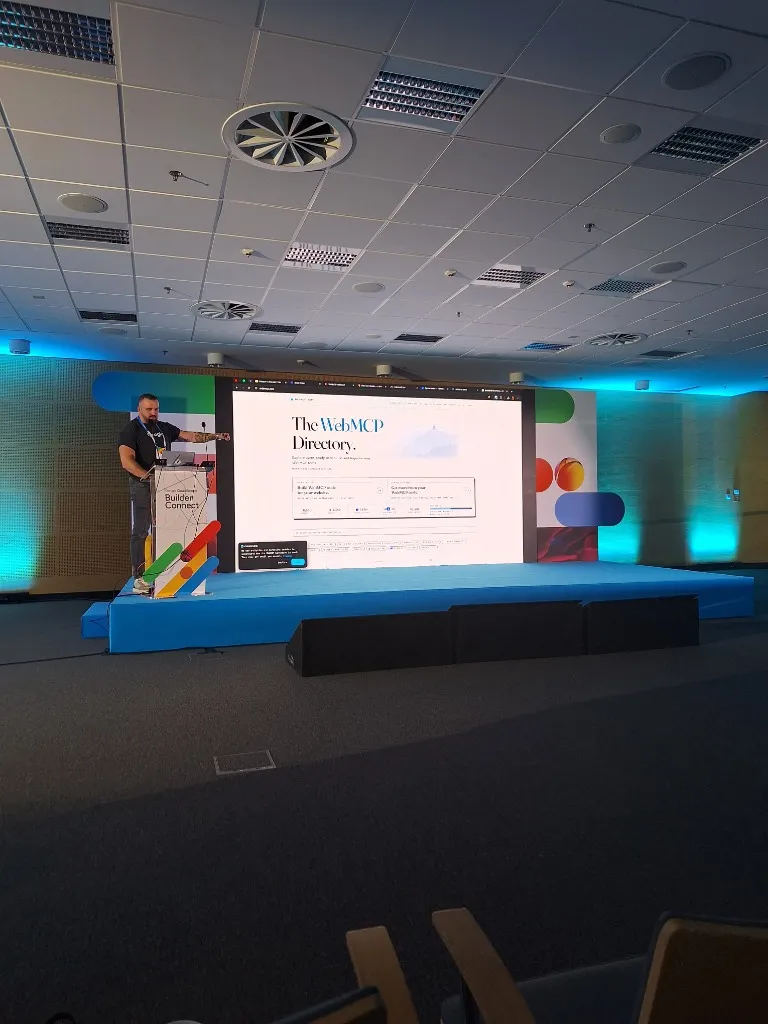
Guiding an agent across a web page usually means brittle DOM scraping or simulating mouse clicks. WebMCP flips that around. Web applications can declare structured tools directly, which browser agents invoke through JavaScript APIs with schema validation. It cuts out the guesswork of clicking dynamic page elements.
Curious to test this firsthand, I tried WebMCP today using the WebMCP Local Agent Chrome extension hooked up to an Ollama instance running qwen2.5-coder:32b. When I navigated to the WebMCP directory, the agent immediately discovered the exposed tools alongside its built-in ones.

The structured tool dispatch worked as advertised, but executing local agent reasoning loops in the browser comes with real hardware costs. Running the 32B model locally pushed my Apple M3 Pro GPU straight to 100% and unified memory to 93%.
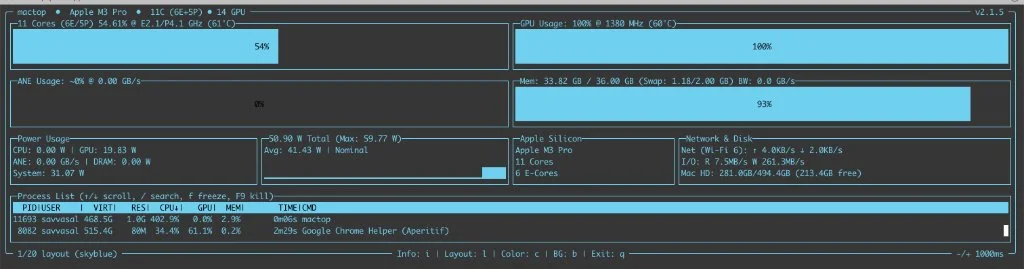
It is a promising pattern for ditching brittle DOM selectors, but it also shows why production client-side agents will likely rely on smaller distilled models or hybrid cloud handoffs when running on local machines.
Legacy Realities and the Evolution of the Frontend
Between sessions, I spent time talking with engineers in the hallways. Two topics kept coming up.
First, legacy codebases still dominate production. Conference talks naturally highlight greenfield projects and clean setups. In practice, most engineering teams spend their days maintaining systems built years ago, complete with relational databases and intricate business logic. Autonomous agents need to understand and safely patch legacy code rather than assuming a clean slate.
Second, the role of frontend interfaces is changing. Complex navigation menus and endless forms are making room for conversational workflows and clear checkpoints. Buttons still have a critical job, but that job is shifting toward human-in-the-loop review. The interface becomes the place where an engineer inspects what the agent prepared, reviews the output, and approves the action. You let the agent do the heavy lifting while you stay in control, without babysitting a terminal.
Reflections from the PKP Train Back to Łódź
Riding the PKP train back to Łódź Fabryczna gave me quiet time to process the day.
I unpacked the Builder Connect swag bag on the train table: comfortable socks, a T-shirt, and a funny printout from an AI photo booth that placed me in a tuxedo on a red carpet.

The swag was fun, but the real takeaway was how grounded the conversations were. Conferences can easily drift into marketing demos and vendor slogans. Here, engineers were openly discussing practical production trade-offs: catching false greens before users see them, running zero-trust GitOps so we can step away from the terminal, and connecting agents to real legacy systems.
When code generation becomes practically free, our attention belongs on architectural guardrails, evaluation suites, and thoughtful human checkpoints. I am curious to see how teams balance that in practice. Do you lean more on strict static checks, or are you spending more time building synthetic test datasets?
Further Reading & References
- Google Cloud Summit Poland.
- WebMCP Specification, the open web standard enabling web applications to expose structured JavaScript tools directly to client-side AI assistants.
- WebMCP Local Agent Extension, Chrome Web Store extension for running local WebMCP agents.
- webmcp-tools Repository, open source Chrome Labs tools for client-side agent integration.
- Model Context Protocol (MCP), an open standard connecting AI assistants to external data sources and developer tools.
- Vertex AI Gen AI Evaluation, structured evaluation metrics for foundation models.
Exploring GitOps guardrails, synthetic evaluations, or agentic tooling?
Let's grab a coffee and talk about production guardrails, WebMCP experiments, and keeping AI coding agents safe in CI/CD.
Grab a CoffeeTransparency Disclosure: In compliance with transparency guidelines for AI-assisted content under EU policy, please note that this article was co-authored by Savvas Alexandrou and Gemini 3.8 Flash.