
My Old-School Superpower: Why Emacs Skills Still Rock in the Age of AI and Modern IDEs
Evolution Note: This post was written in September 2025 and reviewed/validated in July 2026. As system complexity scales with generative AI, LLM agents, and autonomous pipelines, having an “old-school superpower” like deep debugging, raw database proficiency, and structured systems thinking is more critical than ever. Ultimately, it is the reason why my automation and AI builds do not break: they are designed and built by someone who understands the foundational layers underneath. If you’re looking for resilient, production-ready AI and automation solutions, visit my homepage or book an architecture review session.
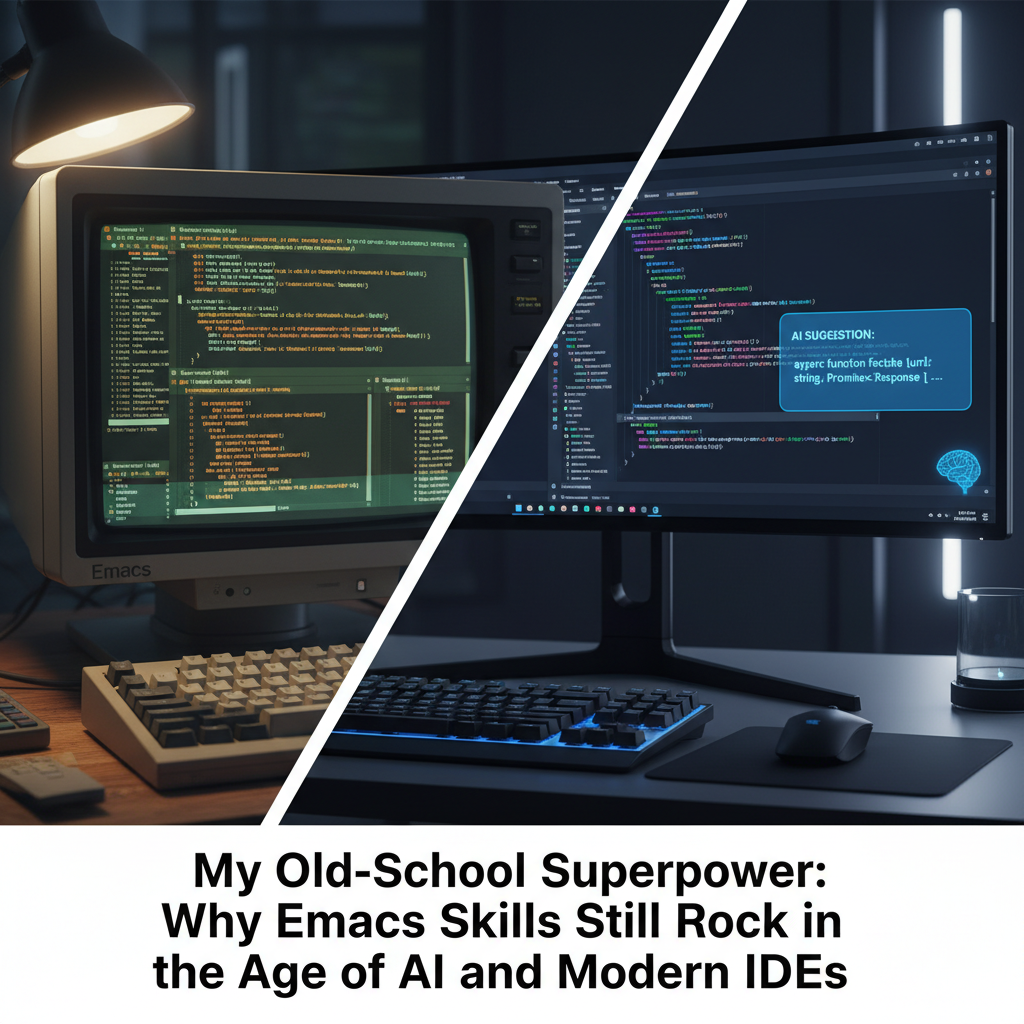
Recently, I SSH’d into a server to edit configuration files. Instinctively, my fingers opened multiple Emacs buffers, copy-pasting and multi-editing with ease. It felt like riding a bike—a skill honed years ago but rarely used today in favor of VS Code or JetBrains.
In an era of feature-rich IDEs and AI code generation, are terminal editor skills still relevant? Absolutely. Foundational text-editing and terminal skills are more critical than ever.
The Unavoidable Command Line: Your Server’s Best Friend
Modern dev ops means working directly on remote servers, cloud instances, or Docker containers where graphical IDEs aren’t available.

Here, SSH and a lightweight terminal editor like Emacs or Vim are your primary tools. Quickly adjusting an Nginx config, checking log files, or fixing a script in production requires command-line proficiency, not a mouse. It’s the digital equivalent of fixing your own car—essential for rapid diagnostics.
Beyond Basic Editing: Multi-editing as a Superpower
Manipulating large text blocks, writing macros, and using regular expressions are tool-agnostic superpowers.

While modern IDEs offer multi-cursor support, mastering structural text manipulation is what saves hours when refactoring codebases, converting data, or cleaning AI-generated outputs.
AI is a Co-Pilot, Not an Unchecked Autopilot
The rise of AI tools is revolutionary. But in software development, treating AI as an unchecked autopilot is a recipe for silent failures.

Raw AI outputs require review, debugging, and systems-level integration. This is where foundational engineering skills come in: you must understand the code to guide it. In the context of autonomous agents, they don’t succeed in a vacuum—they rely on deterministic scaffolding, validation layers, and robust architectures designed by human engineers. To build reliable autonomy, you must first master the layers underneath.
Versatility in a Diverse Tech Landscape
A versatile developer might touch a modern JS framework one day and a legacy Perl script on a remote server the next. Working comfortably in a text-only terminal shows a fundamental understanding of computing. Being independent of heavy graphical IDEs provides flexibility and career resilience.
The Hybrid Developer
The most effective developers leverage AI and modern IDEs for speed, but possess the deep, foundational skills to work in any environment.
My Emacs experience isn’t just nostalgia; it’s a vital tool that pays daily dividends. Investing in terminal editor and command-line skills makes you a highly versatile, resilient, and efficient engineer.
What are your thoughts? Do you still use terminal editors, or have you transitioned entirely to modern IDEs?
Transparency Disclosure: In compliance with transparency guidelines for AI-assisted content under EU policy, please note that this article was co-authored by Savvas Alexandrou and Gemini 3.5 Flash.