
CQRS is the Secret Weapon for LLM Agents
Most LLM-based agents are built as monolithic loops: a single, massive LLM call that is supposed to parse user intent, mutate database state, compute aggregates, and format a response all at once.
It works in a demo. In production, it falls apart. You get 10-second latencies, skyrocketing token bills, and the constant risk of an agent hallucinating and wiping out a database table because it got confused by a tool definition.
Giving a probabilistic system direct write access to your state is an architectural mistake.
The fix isn’t a new agentic framework or better prompting. It’s a classic enterprise software pattern: Command Query Responsibility Segregation (CQRS). By separating data ingestion (the Write path) from cognitive synthesis (the Read path), we can build agents that are fast, cheap, and deterministic.
The Danger of the Monolithic Loop
Take a simple Slack bot that tracks personal expenses. A user sends:
User: “I just spent €45 on dinner with clients.”
A standard monolithic agent handles this by sending the message to an expensive, high-reasoning LLM along with 20 tool definitions. It waits for the LLM to select and call write_expense, executes the write, and then prompts the LLM again to read the database, calculate the remaining weekly budget, and format a reply: “Logged €45. Your remaining weekly budget is €155.”
This design is slow, expensive, and unsafe. First, it introduces high latency as the user waits on multiple LLM round-trips just to append a row of text. Second, it spikes costs by burning tokens on high-reasoning models for a task that is essentially string parsing. Finally, it risks state corruption. Because the LLM has direct write access, a single bad prompt or unexpected message can cause it to mistake a simple search for a delete command.
The Solution: CQRS for LLMs
CQRS separates operations into two paths: Commands (writes that mutate state but return no data) and Queries (reads that return data without side effects).
In an LLM architecture, this translates to separating Memory Ingestion (the Write path) from Cognitive Synthesis (the Read path).
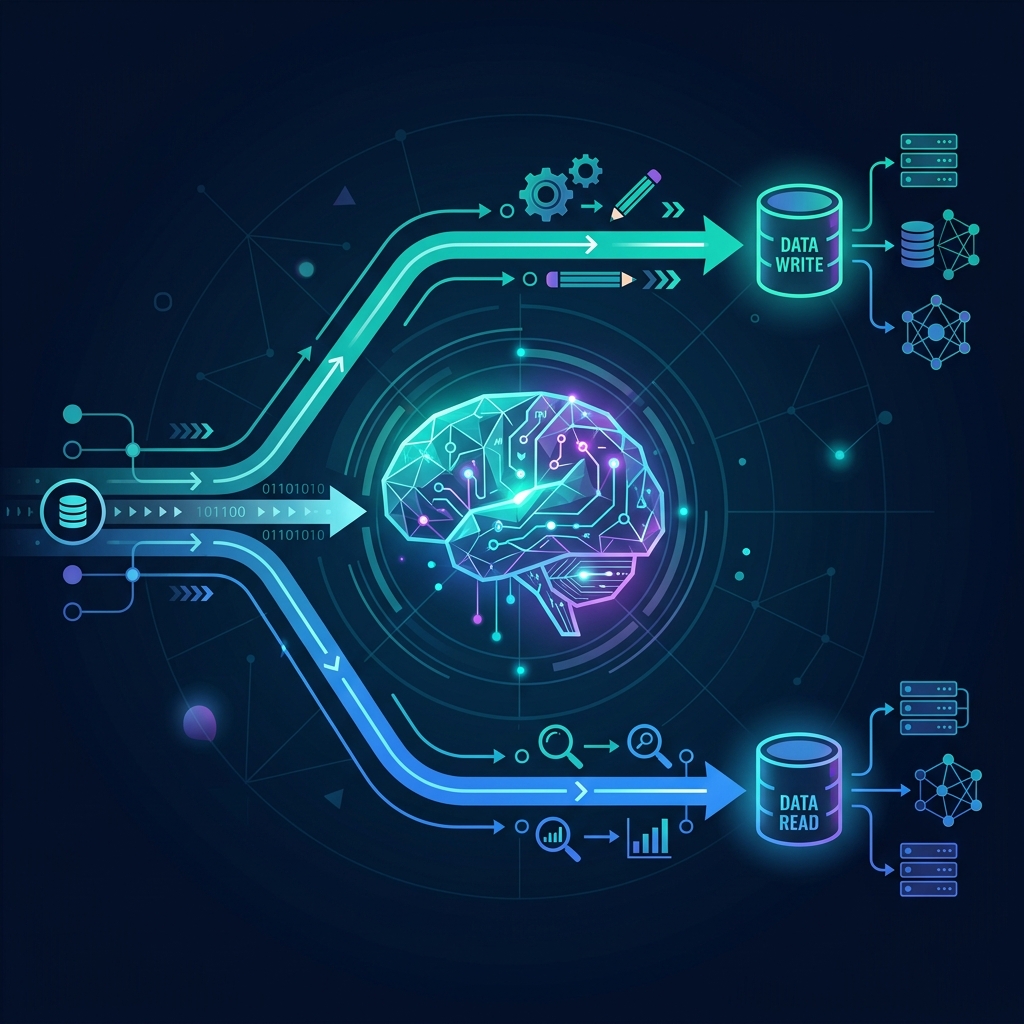
By splitting these paths, we align our computing resources with the actual difficulty of the task. Writing is a low-cognition, deterministic task that needs to be fast, cheap, and safe. Reading and synthesizing is a high-cognition, probabilistic task that requires deep context and reasoning.
Redesigning the Slack Bot with CQRS
Instead of a complex database, let’s use an append-only Google Spreadsheet as our transaction ledger.
1. The Write Path (Command): Dumb, Fast, and Cheap
When a user inputs: “I just spent €45 on dinner with clients.”:
- A lightweight router (a regex or a cheap classifier like Gemini Flash) identifies the intent as a Write.
- A simple parser extracts the entities:
€45,Dining Out,dinner with clients. - The system appends this raw data and a timestamp directly to the Google Sheet.
- The bot responds: “Logged: €45 under Dining Out.”
Because this path does not read the sheet’s history, calculate totals, or load context, it is near-instantaneous. There is no write tool exposed to the LLM; the operation is hardcoded as append-only.
2. The Read Path (Query): High-Cognition Synthesis
When the user asks: “How much did I spend on dining out this month?”:
- The router identifies this as a Read.
- The backend fetches the raw ledger from the spreadsheet.
- It packages the raw transactions into the prompt context of a high-reasoning LLM.
- The LLM acts as an on-the-fly analyst, returning: “You’ve spent €230 on dining out this month. Your largest expense was €120…”
The query path has zero write capabilities. No matter how much the LLM hallucinates, it cannot mutate or corrupt the underlying financial data.
Implementing the Split
Splitting this in code is straightforward:
from typing import Dict, Any

def route_message(message: str) -> str:
    # Cheap LLM call or regex to return "COMMAND" or "QUERY"
    ...

def handle_command(message: str) -> str:
    # 1. Parse entities using a fast model
    details = extract_expense_details(message) # {"amount": 45.0, "category": "Dining"}

    # 2. Hardcoded, append-only write
    append_to_ledger(details)
    return f"Logged €{details['amount']} to {details['category']}."

def handle_query(message: str) -> str:
    # 1. Fetch raw data (Read-Only)
    raw_history = read_ledger()

    # 2. Let a high-reasoning LLM synthesize the answer
    return synthesize_report(message, raw_history)

def handle_slack_event(event: Dict[str, Any]):
    message = event["text"]
    intent = route_message(message)

    if intent == "COMMAND":
        return handle_command(message)
    elif intent == "QUERY":
        return handle_query(message)
Scaling the Read Path
The biggest advantage of CQRS shows up when you scale. When your transaction history grows from 50 rows to 50,000, passing the raw log into the prompt context becomes impossible.
With CQRS, your Write path stays exactly the same. You continue appending raw records cheaply and quickly.
To scale the Read path, you project the write log asynchronously into specialized read models:
For aggregates and calculations, a background worker can sync new ledger entries to an SQL database. When the user asks for their average monthly spend, you execute a fast, deterministic SQL query like SELECT AVG(amount)... and pass only the result to the LLM to format the response.
For semantic search, another worker embeds transaction descriptions into a vector database. When the user asks when they bought a specific item, you run a vector search to pull only the matching rows into the LLM’s context window.
For complex relationships, you can project the same transactions into a graph database to analyze dependencies or vendor connections.
                  ┌───────────────┐
                  │ User Message  │
                  └───────┬───────┘
                          │
                  ┌───────▼───────┐
                  │ Fast Router   │
                  └─┬───────────┬─┘
            Command │           │ Query
                    ▼           ▼
             ┌──────────┐   ┌───────────┐
             │  Write   │   │   Read    │
             │ Pipeline │   │ Pipeline  │
             └────┬─────┘   └─────▲─────┘
                  │               │
                  ▼               │ Read
             ┌──────────┐         │ Context
             │  Event   ├─────────┼──────────────┐
             │  Store   │         │              │
             └────┬─────┘         │              │
                  │               │              │
                  │ Async Sync    │              │
                  ▼               │              │
             ┌──────────┐   ┌─────┴─────┐  ┌─────┴─────┐
             │  Vector  │   │  SQL DB   │  │  Graph DB │
             │  DB      │   │(aggregates)  │(relationships)
             └──────────┘   └───────────┘  └───────────┘
By treating the write log as your single source of truth (an Event Store), you can spin up, modify, or rebuild your read databases without ever risking the core data.
Wrap Up
LLMs are reasoning engines, not database servers.
By applying CQRS to agent architectures, you protect your data integrity, slash latencies, lower API costs, and build a system that can scale from a simple spreadsheet to multiple specialized databases.
Building an LLM agent or workflow automation pipeline? Let’s design a blueprint that won’t break in production. Book an Architecture Blueprint Session or reach out directly at savvas@alexandrou.eu.
Transparency Disclosure: In compliance with transparency guidelines for AI-assisted content under EU policy, please note that this article was co-authored by Savvas Alexandrou and Gemini 3.5 Flash.